

Support CleanTechnica’s work through a Substack subscription or on Stripe.
Toward the end of our visit in Guangzhou, China, we attempted to take an electric river cruise but couldn’t figure out how to get there in time due to road closures from the light festival. Looking at the map for other things to do, we saw a showroom for BYD’s Fang Cheng Bao (FCB) premium SUV brand and the craft beer bar Beer Hardcore next to it. Few things are more American than craft beer and rugged SUVs, so we headed over to check out the Chinese versions.

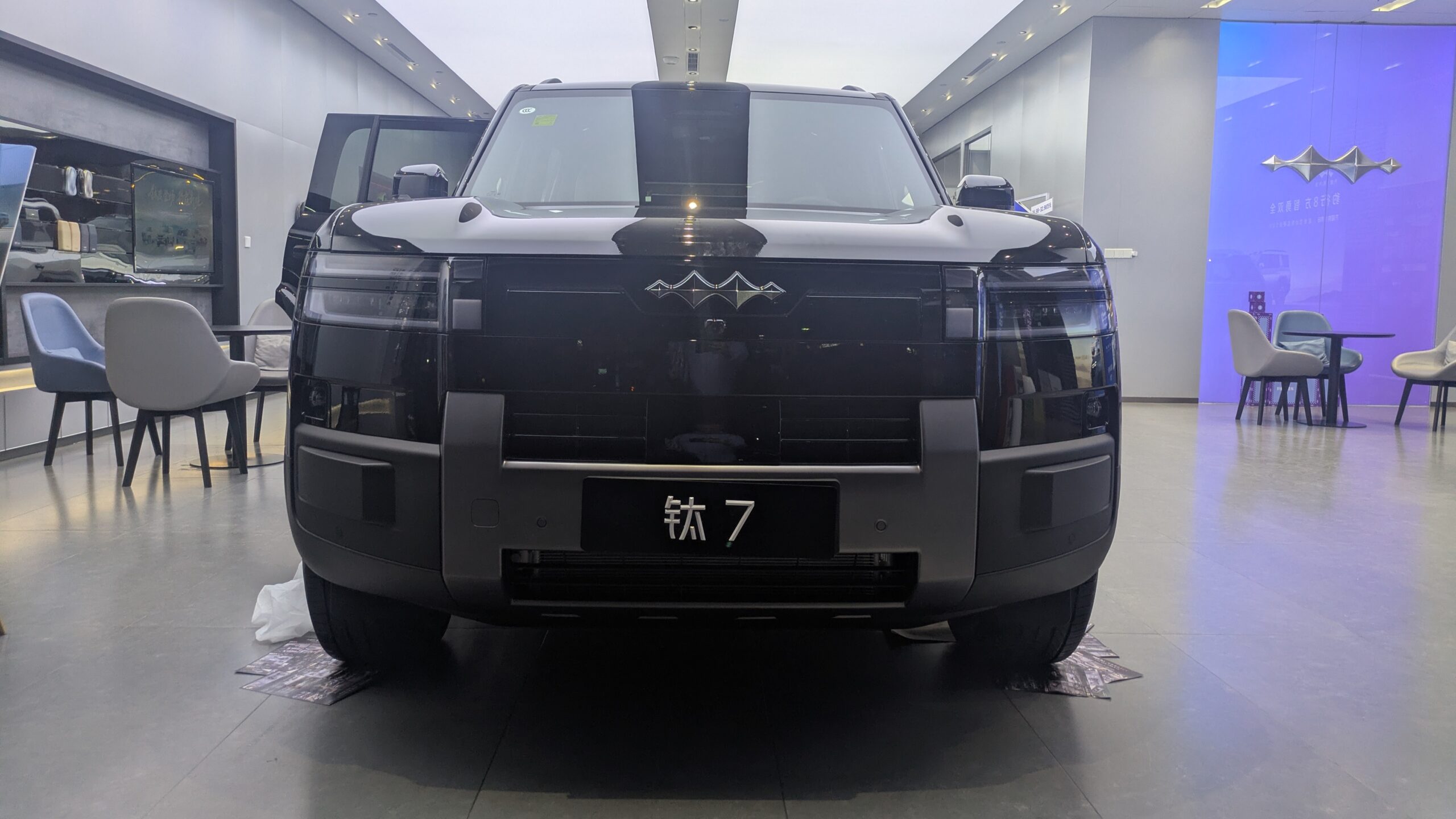
Front and center at the dealership was the Ti7 (aka, Titanium 7) 4WD Max Edition, which is the focus here. Overall, this unibody vehicle claims some off-road capability, but is more on-road focused than their body-on-frame Leopard 5. Think of it as the equivalent of a Range Rover Sport, rather than a Defender. Compared to that Land Rover, the Ti7 is only a couple of inches longer and taller. It is hard to get a sense of scale from pictures, but the squared off body looks more imposing in person.

While the Ti7 and Range Rover Sport PHEV look similar on paper, there are significant differences. The Range Rover Sport is an ICE-first PHEV with a large engine and small electric motor. Despite the range rating, the engine needs to come on for moderate acceleration. The Ti7, meanwhile, is EV-first with large electric motors and a small combustion engine to primarily extend range. That powertrain makes the Ti7 quicker to 100 km (4.5s vs 4.9s). It charges faster (72 kW vs 50 kW). Rated at 190 km CLTC, the Ti7 also has more range than the Range Rover Sport’s 116 km WLTP, but the exact margin is hard to determine based on different testing standards. Likewise, when the battery is depleted, fuel consumption of 6.4 l/100 km (37 mpg) is undoubtedly better than with the Range Rover (21 mpg combined EPA), but equivalent testing would be needed to know exactly how much.

Moving to the inside, the Ti7 removes the questionably-styled crystal switches on some other FCB models and relocates the shifter to the column, freeing up center console space for storage and the included refrigerator. Packaging is more efficient with more legroom and over 4” more headroom compared to the panoramic roof Land Rover Sport (1093 mm vs 985 mm). Seating position is comfortable front and rear. The cargo area can be configured for camping, which is increasingly popular in China. Overall design is more modern than with the Land Rover, which still has an abundance of the gloss “piano” black plastic that was recently on-trend. Materials in the leather interior felt on par with the Range Rover Sport and above a Land Cruiser. Fit and finish seemed solid. The Ti7 comes with heated and ventilated front and rear seats, front massage, and extending passenger leg rest. Technology on the TI7 was clearly more advanced. The Range Rover Sport has moved many controls to a 13.7 in. control screen. The Ti7’s screens are prolific in comparison, with a 15.6 in. central control screen, 12.3 in. front screen, 26 in. W-HUD, 2 AC control screens and up to two 13 in. BYD Pads for rear passengers that mount to the seatback. In addition, the Ti7 comes with BYD’s God’s Eye C intelligent driving system.

In the 4WD Max trim that I saw, the Ti7 comes to 206,800 RMB ($29,420) on their website. There is also a 2WD version with much less power for a little less and a top model with Huawei’s off-road, LiDAR-equipped ADAS system for a little more, but the 4WD Max is the most equivalent model to the Range Rover Sport. Some readers might think that all Chinese prices are low, but the Range Rover Sport PHEV comes in at 1.36 million RMB ($193,000). For that price, you could buy not only the 4WD Ti7, but also the offroad-focused body-on-frame Leopard 5 (269,800 RMB), the 7-seat Leopard 8 (379,800 RMB), and the BEV 4WD Ti3 (153,800 RMB). And after buying all 4 SUVs, you would still have a lot of money left over for options and accessories, like rooftop drones, electric skateboards, etc.

It goes without saying that America can’t get this car, although I could see it selling very well. It is also selling well in China. It led the specialized BYD sub-brand to 37,405 sales in November, ahead of many full-line manufactures. Sales were so strong that when I asked the dealer about it in November, he said that they were sold out for the year and were not accepting orders at the time due to the backlog. However, BYD is currently in the process of increasing capacity to reach demand and recently announced that they would be rolling the model out to Thailand.

Thinking About it Over a Beverage
After leaving the Fang Cheng Bao dealership, my wife and I started talking about what we just saw at the bar next door. Overall, it was obvious why the Ti7 was selling so well in China, and it would undoubtedly sell well in the US if we was allowed to choose it. In many ways, it is better than a Land Rover that costs far more. However, people buying a Land Rover are not just buying a car based on its objective merits. People are buying exclusivity and reputation. They are buying the British origin. Not only are they buying a brand, but also the history that comes with that brand. Clearly, a new brand does not come with that storied automotive history.
The conversation then shifted to things that we still do better in the US. You can find some good craft beers in China at places like Beer Hardcore, with some infusing local flavors. However, it is easier to consistently find good options in the US. One of the best beers we sampled came from Liberty Brewing, brewed in China but run by somebody from America. The US also does certain styles and flavors better. China has barbecue, but it isn’t the same as Kansas City. And NYC is still famous for pizza and bagels. Hollywood still makes great movies….
In many ways, visiting Guangzhou feels like visiting the future. Almost everything is new and technologically advanced. On the way home, I met a young man named Jarvis, who was travelling with his wife and friend from China to New York City to visit. I asked him about what he was interested in seeing, so that I could give him a few tips. He was most interested in the historical aspects of the city and wanted to try steakhouses and craft beer. It reminded me of how we always want to see the historical sites and eat the most local food possible in Europe when we visit.
People have different values. Beyond the objective qualities of a product, people have a wide range of tastes and preferences. Some may place value in national origin. I encourage people to put value into small local businesses, especially those with long histories. Industries will change and evolve, and that process is necessary for progress to happen. But new technology shouldn’t be seen as the enemy. Especially when that technology is better for the environment and can save people money. Saving resources that can be applied to other value creation and exchange. People should have the freedom to exchange the value they create through their work for what has more value to them.
Many Americans would see the value in the Ti7 and other clean technology from China, if they was allowed to get it. Many Chinese also see the value in Western products, flavors, and brand histories.
For this holiday, I hope everyone can get what they value most. And, once you are done driving for the day, raise a glass of your preferred beverage to a better year in 2026. Cheers!

Sign up for CleanTechnica’s Weekly Substack for Zach and Scott’s in-depth analyses and high level summaries, sign up for our daily newsletter, and follow us on Google News!
Have a tip for CleanTechnica? Want to advertise? Want to suggest a guest for our CleanTech Talk podcast? Contact us here.
Sign up for our daily newsletter for 15 new cleantech stories a day. Or sign up for our weekly one on top stories of the week if daily is too frequent.
CleanTechnica uses affiliate links. See our policy here.
CleanTechnica’s Comment Policy
