

The medium- and heavy-duty electric vehicle landscape has transformed dramatically over the past five years. In early 2020, electric trucks were a rarity on U.S. roads, and most fleets were only beginning to think about how electrification might fit into long-term transition plans. Today, the electric vehicle market looks very different: Rapid maturation has led to the deployment of over 38,000 medium- and heavy-duty electric trucks across 386 fleets, shifting from initial pilot projects to early-scale adoption.
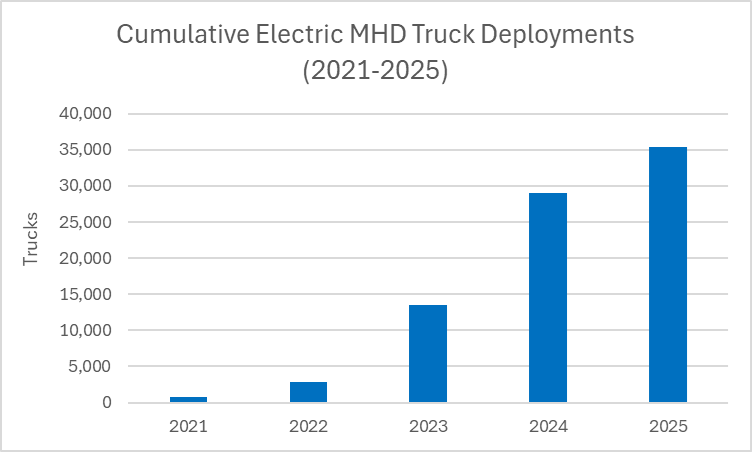
In 2020, there were a total of 219 electric trucks on the road, according to EDF’s Electric Fleet Deployment & Commitment List, with announcements spread across 66 companies. During this time, fleets were starting to make public commitments to deploy electric trucks and largely focused on pilot projects or initial learning efforts. Several of these early commitments, like Amazon’s announced order of 100,000 Class 2b Rivian vans in 2019, signaled where the market was headed as technology improved and more options became available.
Electric truck deployments sustain momentum through a challenging 2025 Share on X
By 2021, that acceleration became evident. The market saw the first major increase in deployments, with 611 trucks hitting the road in a single year, bringing the total above 800. Growth accelerated further in 2022, as the cumulative total of electric trucks on the road reached 2,898. That year also marked a turning point in the scale of fleet commitments, with more fleets announcing larger orders of electric vehicles. Notably, the U.S. Postal Service committed to transitioning their delivery fleet to electric with 45,000 Next Generation Delivery Vehicles, and Walmart committed to over 10,000 electric vehicles across several manufacturers for last-mile delivery.
The passage of the Inflation Reduction Act in 2022 set the stage for rapid growth of the MHD electric vehicle market in 2023 and 2024. IRA investments paired with strong vehicle standards helped set clear direction for manufacturers, fleets, utilities and infrastructure providers to advance cleaner truck technologies — delivering meaningful air quality and public health benefits in communities. This jolt in funding and expanded market access, along with fulfillment of earlier orders as production time decreased, led to a record year of deployments in 2023, with 10,675 trucks deployed. Momentum continued in 2024, which surpassed the previous year’s record, with 15,431 deployments. In total, 26,106 MHD electric trucks were announced over two years, compared to 2,898 over the previous several years of tracking.
After consecutive years of exponential growth, the electric vehicle market entered 2025 facing heightened headwinds after the repeal of the Inflation Reduction Act, but major investments from previous years laid the foundation for continued progress. Despite the challenges, 2025 still saw continued investment in electric vehicle infrastructure, as fleets committed to or placed on order more than 134,000 MHD electric vehicles nationally since the passage of the Inflation Reduction Act.
Announcements of new vehicle deployments remained strong in 2025, with 9,139 deployments announced during the year. This represents a modest 14% decline from 2023, the second highest year on record, for a deficit of only 1,536 trucks. As the third-highest deployment year on record, 2025 proves that zero-emission vehicle solutions are still viable.
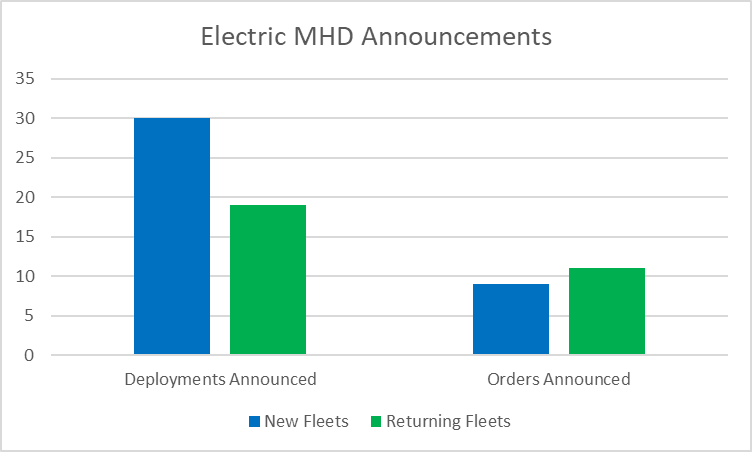
In addition to deployments, 2025 saw broadened participation across companies with 49 new fleets announcing deployments, and 20 fleets announcing new order commitments. In 2025, 61% of fleets announcing deployments were doing so for the first time. At the same time, nearly half of the fleets placing new orders already had an existing electric MHD order or deployment announced, signaling continued confidence among those early adopters.
While 2025 began with uncertainty, the year ended with a robust number of new MHD electric vehicles hitting the road. Looking ahead, 2026 will likely face continued headwinds from changes to incentives or economic and supply chain constraints. Even so, electric trucks remain viable solutions to reduce emissions and improve financial and operational efficiency. Because of this, fleets will remain well positioned to shape the next phase of the zero-emission transition and make zero-emission technologies standard, not the exception.
Fleets can continue to move the market forward by:
- Setting ambitious goals with a clear path to implementation and success.
- Engaging constructively with policymakers and trade associations to align their influence with climate and clean air goals.
- Showcasing progress and sharing best practice to normalize solutions and reduce perceived risks amongst peers.
- Advocating for durable policies and investments that support market development for clean vehicle manufacturing and grid readiness.
Since 2020, the transportation industry has made great strides in improving the health of our communities and reducing harmful pollutants from diesel trucks, but we must sustain momentum to achieve 100% zero-emission truck sales and net-zero emissions by 2040.
Fleets interested in starting or continuing their electrification journey can check out EDF’s Fleet Electrification Solution Center for resources, and EDF’s Electric Fleet Stories case studies series to see how other fleets are making alternative fuels work. Additionally, Electric Fleet Deployment & Commitment List tracking tool has up to date data on orders, deployments, and commitments. Stay tuned for new and exciting updates to the Deployment & Commitment List coming in 2026.
